
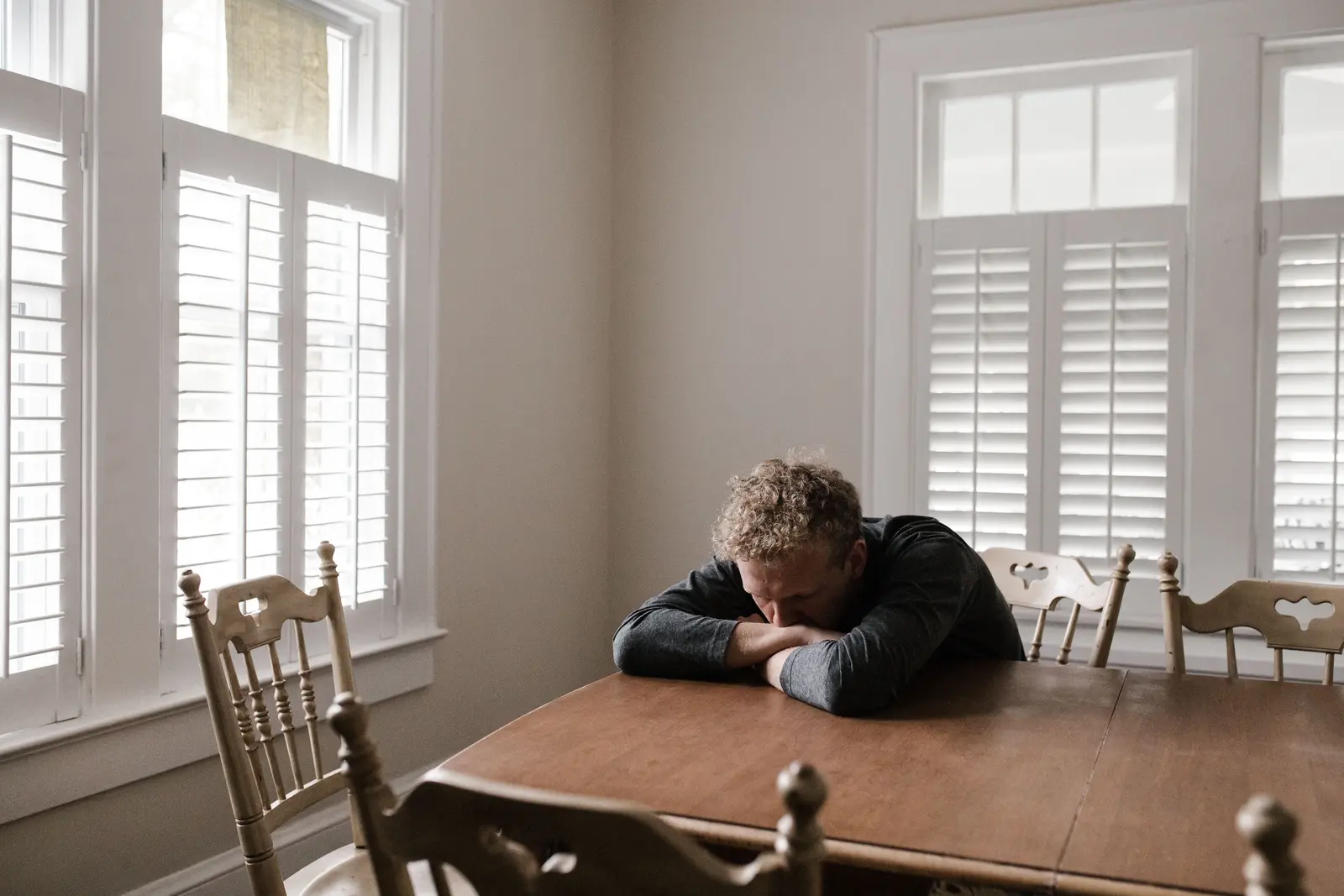

Here's something I tell every guy I coach in his first few weeks: the state you're in decides what you can see. Not what's true. What you can see.
When you're exhausted, wound up and angry, your brain goes hunting for threats and problems. It's not being dramatic. It's doing its job, badly, the same way a smoke alarm does when you're just making toast. A stressed brain is built to scan for danger, not options. When you're calm, fed, rested and moving, the same brain starts finding solutions instead. Same facts. Same problem. Completely different output.
This doesn't mean your problems disappear if you go for a jog. Your problems are still there, patiently waiting like a bill in the letterbox. What changes is your capacity to deal with them well.

Why the 2am Version of the Problem Isn't the Real Problem
You know the 2am spiral. You're lying there and the thing you're worried about, money, your marriage, your job, feels catastrophic. Unsolvable. The kind of thinking that would win an Oscar for Best Overreaction if that were a category. Then you sleep, you get up, you train, you eat something, you talk to your mate or your partner, and by 10am the same problem looks like something you can actually handle.
Nothing about the situation changed. You did.
That gap between the 2am version and the 10am version is the whole point of this article. If you make decisions, send messages, or have conversations from the 2am state, you are making decisions with a brain that is temporarily worse at its job. Not permanently. Temporarily. But you don't get to undo the text you sent at 2am just because you feel different at 10am, there's no "actually, ignore my last text" button that un-sends the damage.
Your Body Is the Fastest Lever You Have
Most guys try to think their way out of a bad state. They sit there and turn the problem over and over, hoping if they just think about it hard enough they'll land on clarity, like rubbing two thoughts together and hoping for fire. That's backwards. You don't think your way into a better state. You move your way into one.
Your physiology is the fastest lever you've got. Faster than a conversation. Faster than journaling. Faster than trying to "reframe" anything.
Concretely:
- Train. Even twenty minutes. Weights, a run, a bag, doesn't matter, just something that makes you sweat and briefly forget you own a phone.
- Walk outside. Change of environment plus movement plus daylight does more than people give it credit for, it's basically a free mood-altering substance.
- Slow your breathing down on purpose. Four seconds in, six seconds out, ten times. Cheaper than a meditation app subscription.
- Get out of the room you're stewing in. Physically leave. The problem doesn't have legs, it's not coming with you.
Then, and only then, go back to the problem. I'd rather a guy walk around the block for fifteen minutes than sit at his kitchen table wrestling the same thought for another hour, a fight nobody wins and everybody loses sleep over. The thought doesn't get smarter by sitting there longer. It gets stuck.

The Guy Who Kept Firing Off Angry Emails
One guy I worked with, I'll call the pattern rather than the person because I see this constantly, ran a small trades business and had a habit of firing off angry emails to clients and subcontractors the moment something went wrong. A job ran late, a supplier stuffed up an order, whatever. He'd read the email, feel the heat rise, and reply within about ninety seconds, faster than a two-minute noodle and roughly as well thought out. Every single time he did this, it made the situation worse. Clients got defensive. Subs stopped picking up his calls. He was solving nothing. He was just discharging his own stress onto other people and calling it "dealing with it."
We didn't work on his communication skills first. We worked on the ninety seconds. New rule: any email that makes his jaw tighten gets a reply drafted, saved, and sent two hours later, minimum, basically a cooling-off period for his own thumbs. In those two hours, he had to do something physical. Walk the job site, load the ute, anything that got him out of the chair. Nothing else changed for the first month. Just that one rule.
Six weeks in, he told me something that stuck with me: "Half the emails I draft angry, I read back later and delete. They weren't even worth sending." That's the state doing the work, not willpower, willpower was never going to save him from himself at ninety seconds flat. His problems were exactly as real as before. He just stopped adding a second problem, his own reaction, on top of the first one.
Don't Sign Off on Permanent Decisions From a Temporary State
This is the part guys skip. It's easy to nod along with "go for a walk when you're stressed." It's harder to actually apply the rule at the moment it matters, which is usually the exact moment you feel most certain you're right, a certainty roughly as reliable as a weather app three weeks out.
Angry? Don't send the text yet. Exhausted and burnt out? Don't decide your career is a write-off tonight. Mid-argument with your partner? Don't decide the relationship is finished in the middle of the fight.
None of this is about avoiding hard conversations or dodging real problems. It's the opposite. It's recognising that the quality of the person doing the thinking directly affects the quality of the thinking. You wouldn't trust a decision made by someone who'd had four hours sleep and three coffees and no food since yesterday, that man shouldn't be allowed near a calculator, let alone your marriage. So why trust your own decisions when you're in that exact state?
If you struggle to catch yourself before you react, that split second between the trigger and the response is worth building on its own. I go into that in the two seconds that can change an argument. And if you notice you're the guy who's calm with everyone at work and then snaps at your own family the second you get home, that's not a coincidence, that's a resource running dry, which I break down in the inner fuel tank.

What You Can Control When the Facts Won't Move
Sometimes the problem genuinely doesn't move no matter what state you're in. The job is still gone. The diagnosis is still real. Changing your state isn't about pretending the obstacle isn't there, that's not resilience, that's just standing in traffic with your eyes closed. It's about making sure you're the sharpest, steadiest version of yourself when you actually deal with it. If you want the deeper thinking on facing things you can't change, that's exactly the territory I cover in how to use Stoicism when life goes sideways.
TRY THIS THIS WEEK: Pick one recurring trigger this week, an email, a comment from your partner, a work stress, something that reliably winds you up. Before you respond to it, do one physical thing first: a ten-minute walk, twenty push-ups, or ten slow breaths. Then respond. Do this every single time the trigger shows up this week, no exceptions. At the end of the week, write down what actually changed, not how you felt, what you actually said or did differently. Most guys are surprised how much of their "urgent" reaction wasn't urgent at all, it just felt urgent because their nervous system was already redlining.
The Skill Is Noticing the State You're In
You won't always catch it in the moment. Nobody does at first. The skill isn't perfect self-control. The skill is noticing, even a beat late, "I'm making this decision from a bad state" and giving yourself permission to pause before you lock it in. That pause is the whole game. Everything else, the walk, the breathing, the training, is just how you buy yourself the pause.
Common Questions
Why does a problem feel so much worse at 2am than the next morning?
Your state, not the facts, determines what you can see. A stressed, tired brain scans for threats and problems; a rested, calm brain finds solutions. The problem hasn't changed, your capacity to deal with it has.
What's the fastest way to change a bad state?
Your body, not your thinking. Training, walking outside, slowing your breathing down, or physically leaving the room works faster than trying to think your way into a better headspace.
Should I avoid making decisions when I'm wound up?
Yes. Angry, exhausted or mid-argument states produce worse decisions. Change your state first, with movement, breathing or a change of environment, before you send the message or make the call.